
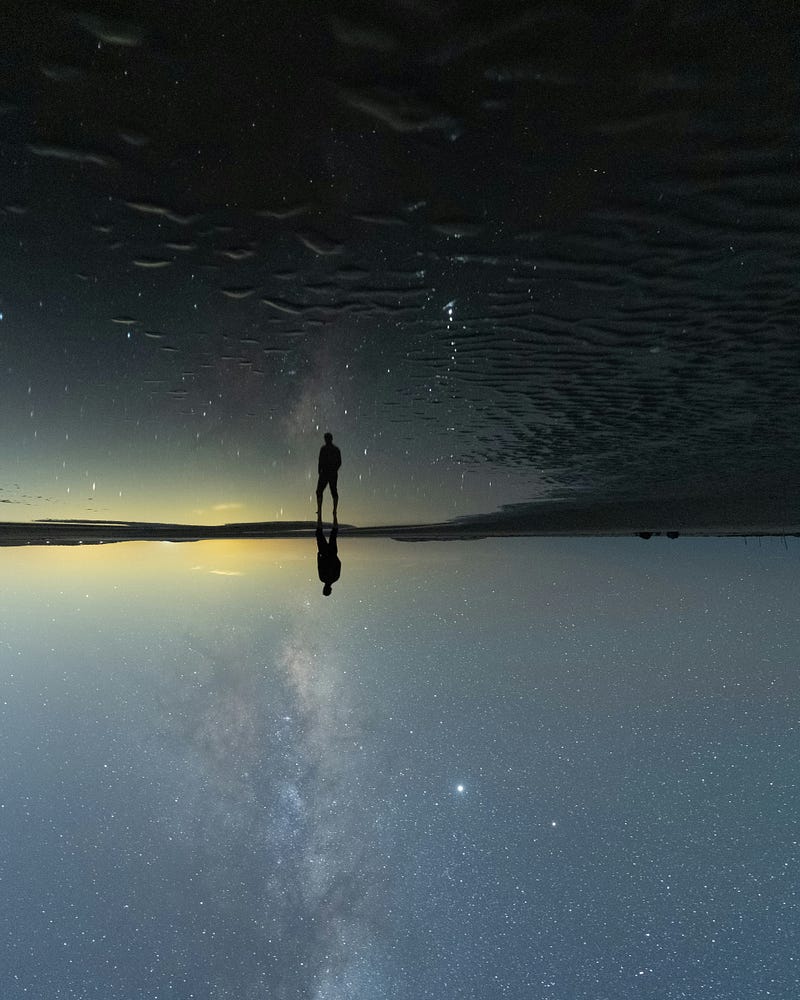
Spending an evening at a beach, sitting on a rock that speaks of your character, observant of the waves traversing playfully towards you, and immersed in the ecosystem of the variety of sounds, is an experience that draws your attention scattered all over to this splendid, raw, grandiose act of nature.
The huge ball of fire disappears behind the seemingly limitless sea, colouring the sky with mesmerising hues, and the flapping wings of the birds dramatically sprinkle the last few drops of paint on this picturesque scenery. Witnessing this, the mind comes to a standstill, at least for a few moments, in awe of Mother Nature’s magnificence.
Understanding the Nature of Reality
In those most profound moments, the world starts to seem surreal. Just some minutes ago, in the hustle of jumping from one thought to another, this world was irrefutably real, but a miraculous inner silence was enough to discard that rigid notion for a few brief seconds and make us experience the dreamlike nature of reality.
If we turn our heads a little up and gaze upon the tiny umpteen bright spots on a darker night, we will soon be overwhelmed by their sheer quantity. There is no end to them. The darkness that acts as a backdrop is, on the contrary, the absence of any limiting plane within our conceivable reach, from which light can be reflected.
What to say about extraterrestrial? Right here on our planet, there are trillions of creatures, some animate and some inanimate. The peculiarity of each of them is spread over a spectrum of infinite possibilities, and within each possibility, there lie innumerable varieties. The depth and length have no termination points and can only come to an end if we stop looking further.
Let’s scale down our view. A single drop of water has 5 sextillion atoms, i.e., 5 followed by 21 zeroes. They were supposed to be made up of atomic particles, but then they discovered sub-atomic particles; maybe even these sub-atomic particles are made of strings or 1-D vibrating energy forms. We haven’t reached the endpoint yet; nevertheless, these magnitudes and scales give us a taste of bizarreness.
The Absurd and the Unknowable
Absurdness is a subtle characteristic that brings a shift in our perception, transgressing the limits of reality and making us feel the surreal nature. As long as rationality prevails and the phenomena make sense, the mind grasps with confidence. The grasping, knowing, and understanding allow it further to plug in various elements of the observable universe in a set pattern and thus admit predictability.
Anything that can be known or grasped should be determinable at first. From our daily experience, we can recognise that determinability is a key factor of reality. We determine the quantity, quality, behaviour, etc., of the objects and use them for various modes of functioning in the real world. These modes of functioning are essential to give us the perception of the very reality.
Absurdity is a state that arises out of a lack of graspability owing to the indeterminable properties of the object. Our regular sense of reality forbids absurdity within its ambit. However, absurdness exists, and we experience it from time to time, but we safely sideline it by categorising it as imagination. For all such instances when ignoring becomes a distant possibility, there is a box of unknowns where the contents are destined to be forgotten after a thorough withdrawal of attention to the corporeal world. Absurdity is thus systematically filtered out of our consciousness, and what’s left is our mundane world that makes sense.
The boundary of the Finite
Determinability, in turn, is dependent upon another key factor of finitude. All finite things are sensical, and we can ascertain some property, form, number, etc., to find meaning. If we observe closely, then our entire objective reality is bounded by finitude. Not a single thing that is real to us escapes this boundary. However, when infinitude is brought into the picture, the conviction of the perception of reality starts to blur.
Although our mind can appreciate the essence of infinity but it can never perceive it the way it perceives finite objects. When it is said that it can appreciate the essence of infinity, it simply means that it releases its faculties from trying to circumscribe the meaning of received information within its limited capabilities. An extremely large number, 5×10²¹, like that of the number of atoms in a drop of water, isn’t able to bind the mind to its default mental activities of attempting to know the absolute value to the same degree as compared to something like the number of seats in a movie theatre.
If you try to distinguish between the 2 large numbers 10³³ and 10³⁵ vs numbers that are in our normal range of operations, say 100 and 1000, you can see how our mind gets comparatively more occupied in grasping the distinction in the latter case. In the first case, it remains relaxed, just observing the distinction and simply appreciating the essence of these grand numbers.
Extending this precept beyond numbers to the qualitative aspects of the objective universe, the mind processes them similarly with a sense of awe. Be it the vastness of the forest or the infinitesimal size of a sub-atomic particle, the distortion of reality is perceived when the scale extends beyond the mind’s regular spread. At this juncture, the illusory nature of the universe magically emerges out of solid reality and reveals itself to an attentive mind.
Leave a Reply